Solar can lower your power bill, but it is not the right answer for every house. The value depends on your roof, the shade across it and how much power you use while the sun is up. We look at those three things first, then design, install and connect a system sized for your household, not the largest array the roof can hold.
Solar also pairs well with an electric car that charges during the day. If an EV is on the way, read our EV charger installation page too, because the two are often planned together.
Pricing: a free quote and a fixed price agreed before we start. You get a written, itemised quote, and small jobs can be quoted from photos.
Is solar right for your home?
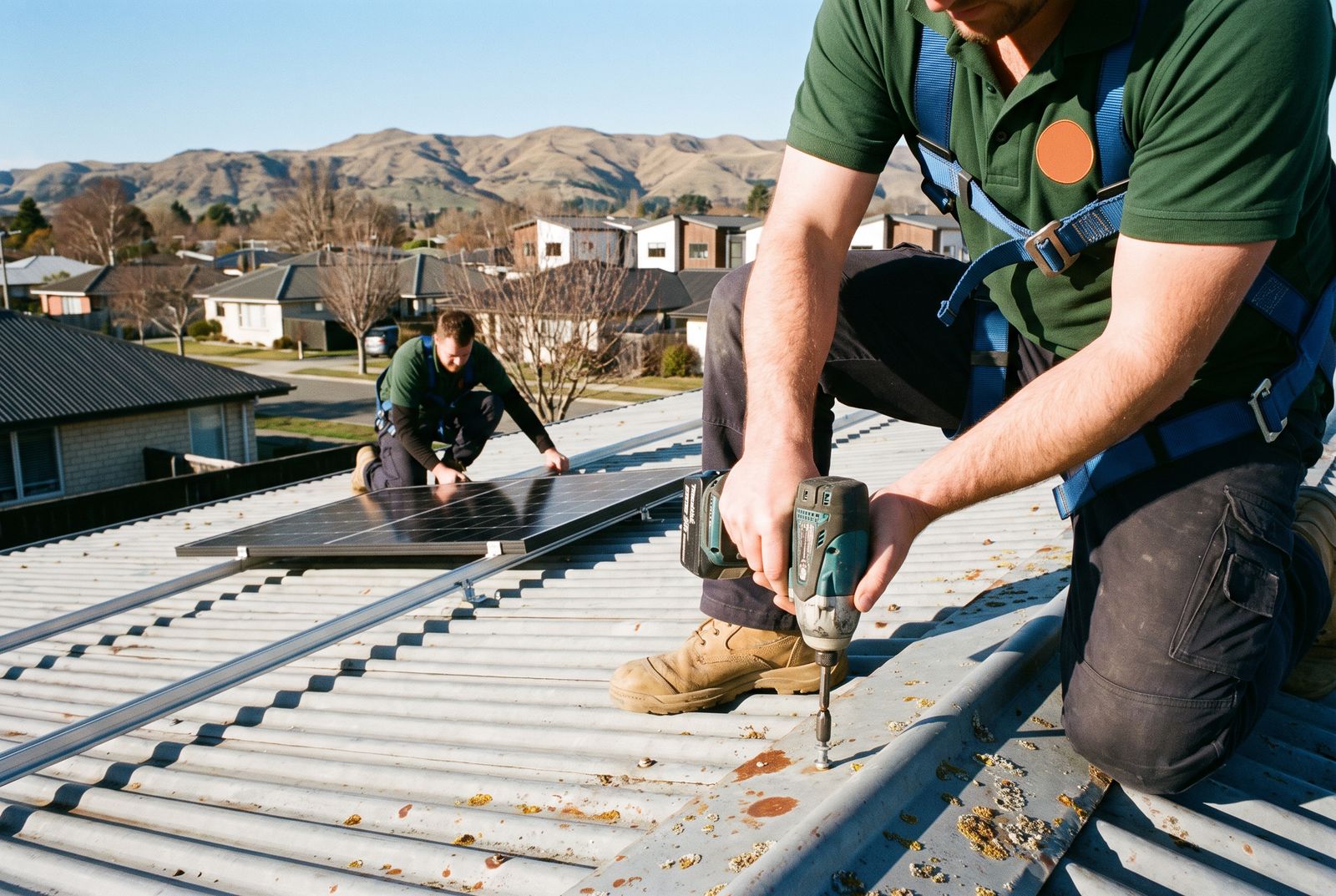
EECA's guidance says north-facing roofs work best. East and west-facing roofs produce less and return less, but can still be worthwhile. Shade from trees, chimneys, neighbouring buildings or the Port Hills cuts output, so we check it at different times of day and think about the low winter sun. In the right circumstances, EECA says a system can pay for itself in as little as seven years.
When you use power matters most. Solar makes nothing at night and the most around midday. Standards New Zealand's homeowner guidance notes that using solar power on site is usually worth more than exporting it, because retailers pay less for exported power than they charge to sell it to you. Households that run the dishwasher, hot water, heat pump or EV charging during the day get the most from it.
- Roof direction: north is best, east and west can work
- Shade through the day and across the seasons
- How much power you use in daylight
- Your switchboard, and whether you are single or three-phase
Orion's rules for Christchurch, Rolleston and Lincoln
Orion runs the lines network across Christchurch city, Selwyn and Banks Peninsula. Its guide for home and small business generation of 15 kW or less sets out the rules every installer must follow. The inverter must comply with AS/NZS 4777, and choosing one from Orion's pre-approved list speeds up the application.
Orion limits how much a home can export. A single-phase connection can export a maximum of 5 kW. A two-phase connection can export up to 10 kW spread evenly across both phases, and on three-phase the difference between phases must not exceed 5 kW. The export limit is recorded on the Certificate of Compliance. After installation, the Certificate of Compliance and Record of Inspection go to Orion within ten working days, and your retailer arranges import and export metering.
- Inverter to AS/NZS 4777, ideally from Orion's pre-approved list
- Single-phase export limited to 5 kW
- Export limit written on the Certificate of Compliance
- Paperwork to Orion within ten working days of install
How It Works
MainPower's rules for Rangiora, Kaiapoi and Pegasus
North of the Waimakariri River the network belongs to MainPower, not Orion, and the rules are different. MainPower approves systems up to 10 kW on single phase, with three-phase systems considered case by case. Its default export limit for small customers is 10 kW, though it is lower on parts of the network that are constrained, and MainPower publishes the connections where lower limits apply.
Inverters must be on the Clean Energy Council list and meet AS/NZS 4777.2:2020. MainPower charges no application fee for systems under 10 kW from 1 October 2026. Export rules and fees are being reformed by the Electricity Authority through to 2030, so we check the current position with your lines company before we quote.
Consent, roofs and Canterbury weather
Since 23 October 2025, Schedule 1 of the Building Act has exempted many roof-mounted arrays from building consent. Building Performance explains that arrays up to 40 square metres in total, in a wind zone no greater than High, do not need consent. Larger arrays, or arrays in higher wind zones, can also be exempt when designed or reviewed by a Chartered Professional Engineer.
Exempt does not mean anything goes. Roofs in Canterbury are designed for snow load as well as wind, and the nor'wester can reach storm force, so we check the roof structure, fixings and wind zone shown on your plans. After the 2011 earthquake, engineering reports recommended replacing heavy concrete tile roofs with lighter materials such as steel, so Christchurch has both, and tile and steel roofs take different fixings. If your home is a scheduled heritage item or sits in a Residential Heritage Area, we check the district plan before anything goes on the roof.
Inverters, batteries and the switchboard
The inverter converts the panels' direct current into the alternating current your house uses, and it has to suit your supply. Older switchboards may need space or an upgrade before they can take a solar supply safely.
A battery stores daytime surplus for the evening and, set up correctly, can keep some circuits running in an outage. Batteries add real cost, so we model whether one suits your usage or is better added later. Often a cheaper way to use surplus is to run the hot water cylinder or EV charging in the middle of the day.
- Inverter matched to single or three-phase supply
- Switchboard checked for space and capacity
- Battery only where the numbers support it
- Monitoring app for production and use
Avoid DIY and plug-in panels
Standards New Zealand published SNZ PAS 6014:2025, a free guide to residential solar and battery storage. It warns about DIY installations and illegal plug-in panels. Solar arrays produce direct current at voltages that do not switch off when the main switch does, so faults can stay live. Orion also requires all wiring to be done by a registered electrician to AS/NZS 3000.
Why Choose Cheeky's Electrical for Solar Installation
Sized to your usage
We look at when you use power and recommend the system that pays back for your household, not the biggest one.
Orion or MainPower application handled
We apply to the right lines company for your address and connect only once approval is in.
Export limits done properly
Inverter settings match the approved limit, and the limit is recorded on your Certificate of Compliance.
One fixed, itemised quote
Panels, inverter, any battery, mounting and switchboard work priced line by line.
Solar Installation FAQs
How much solar can I export in Christchurch?
On Orion's network a single-phase connection can export up to 5 kW. Two-phase can export up to 10 kW spread evenly, and on three-phase the difference between phases must stay within 5 kW.
Is it different in Rangiora or Kaiapoi?
Yes. Those towns are on MainPower's network, which approves up to 10 kW on single phase with a default export limit of 10 kW, lower in constrained areas.
Do I need a building consent for solar panels?
Usually not. Since 23 October 2025, roof-mounted arrays up to 40 square metres in a wind zone no greater than High are exempt. Larger arrays, or arrays in a Very High or Extra High wind zone, can also be exempt when a Chartered Professional Engineer designs or reviews the fixings. The work must still meet the Building Code and district plan, so check with your council if you are unsure.
How long does solar take to pay back?
EECA says as little as seven years in the right circumstances. Roof direction, shade, daytime use and your export rate all change that.
Do I need a battery?
Not always. A battery helps if you use a lot of power in the evening or want backup in outages, but it adds cost. We model both options.
Can I fit plug-in solar panels myself?
Standards New Zealand warns against DIY setups and illegal plug-in panels, and Orion requires all wiring by a registered electrician.
Solar Installation Near You
Find your region or suburb for local solar installation information:
Related Electrical Services
Solar Installation Guides
- Orion Solar Export Limits: The 5 kW Rule Explained
- Is Solar Worth It in Christchurch? Sunshine, Frost and Payback
- Solar Batteries in Christchurch: Worth It With Orion's Export Limits?
See the electrician prices guide or every service we offer.
Sources and further reading
- EECA: Is solar right for your home?
- Orion: Connecting your home or small business generation, 15kW or less (March 2025)
- MainPower: Distributed generation
- Electricity Authority: Orion export limits and fees, Part C
- Building Performance: Solar panel and boundary setback building consent exemption changes
- Standards New Zealand: Free residential solar guidelines (SNZ PAS 6014:2025)
- Metal Roofing NZ: Types of load (snow and wind)
- EBOSS: Lightweight metal roofing recommended post-quake in Canterbury
- Christchurch City Council: Plan Change 13, heritage